
Your AI-ready business context.
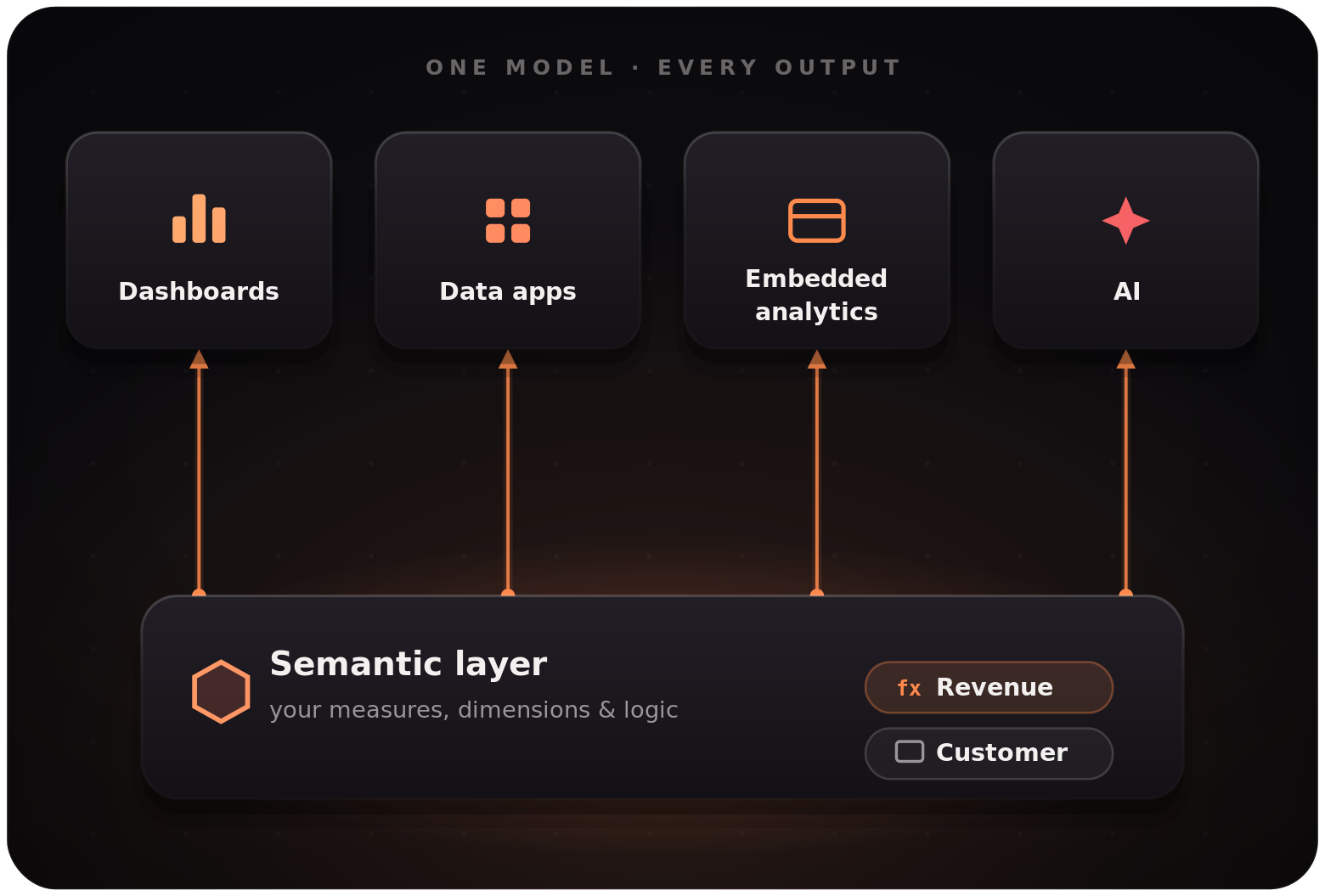
Model your business logic once in Astrato's Semantic Layer, govern it in one place, and let it power dashboards, reports, embedded analytics, data apps and AI – all from a single source of truth.


Give AI the business context it needs to be right.
Your definitions, fields and joins give the model real business context, so answers are accurate – not confident guesses. Only the metadata is ever shared. Your data never leaves the warehouse.


Model once. Run anywhere.
Migrating usually means rebuilding every dashboard and metric from scratch. But Astrato is warehouse-agnostic – model your Semantic Layer once and run it on any warehouse you choose.


Before, we had to maintain a separate data model for every customer. Now we maintain one data layer for everyone and control what each customer sees through the semantic layer. That’s a huge reduction in maintenance – and it means we can onboard a new customer without rebuilding anything.

No metric too complex to model.
Point-and-click for the everyday, raw SQL for the complex, or just describe it to Nash AI, our agentic assistant, in plain English. Whatever the logic, it lives in one governed model, not a rogue spreadsheet.
I benchmarked Astrato against Sigma and other solutions. For us, Astrato was the best – because you get the best of both worlds. You have classic analytical reporting, but you can also build apps with controlled write-back to Snowflake.
Open the data, keep the guardrails
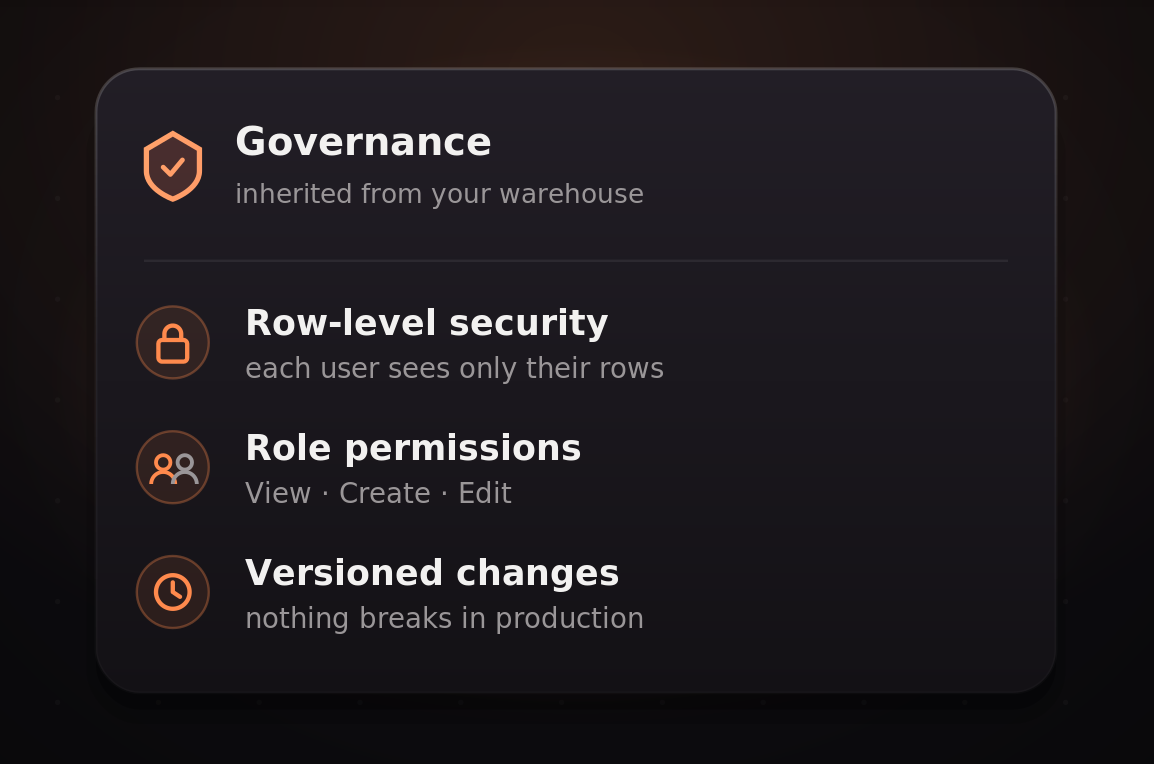
Opening your data to more people – and more AI – usually means worrying about who sees what. Astrato inherits the row-level security and permissions from your warehouse, so everyone sees only their own data, and versioned changes keep a new definition from ever breaking production.
One number everyone trusts.
Dashboards, reports, embedded analytics, data apps and AI all run on the same definitions, so "revenue" means the same thing everywhere. Change it once and it updates across every tool without drift or debates.
See the full library in action

Frequently asked questions
What is a semantic layer, and why do we need one?
A semantic layer is where your business logic lives – the measures, dimensions and join rules that define what "revenue," "active customer" or "margin" actually mean. Define them once in Astrato and every dashboard, report, embedded view, data app and AI agent uses the same definitions, so the numbers stay consistent no matter who's asking or which tool they're in.

Does the AI ever see our actual data?
No. It's the model's metadata – measure definitions, field names and join criteria – that gives the LLM the context to write accurate, business-aware SQL. Your data is never the payload. With Snowflake Cortex, only the query is shared, so no data ever leaves Snowflake.
Do we have to re-model our metrics for every tool?
No. One Semantic Layer feeds dashboards, reports, embedded analytics, data apps and AI. Define "revenue" once and every surface uses the same definition – no per-tool re-modelling, and no metrics that quietly drift apart.
Can business users define measures, or only analysts?
Both. Build measures point-and-click – row-level, conditional and nested – with no code, drop into raw SQL for the complex ones, or just describe the measure to Nash in plain English. Granular View / Create / Edit tiers keep the right people in the right scope.
Can we open access to more people and AI without losing control?
Yes. Astrato inherits the row-level security and permissions you've already set in your warehouse, so everyone – and every AI query – sees only what they should. There's no second permission system to maintain, and every change is versioned, so nothing breaks in production.
What happens when we change a definition?
Edit it once and every workbook and chart that uses it updates automatically. Changes are versioned with rollback, and row-level security and permissions are inherited from the warehouse, so nothing drifts or breaks production by accident.