
The question isn't whether Domo can visualize your data. It's whether you should be paying twice to store it.
A seven-year Domo customer received their renewal notice two months before it was due. The price had increased 1,120% — same number of users, lower data consumption than the prior year. Domo's public response on G2 was polished and sympathetic. The customer's reply: they were rushing a migration.
That review isn't an outlier. It's a pattern that shows up across G2, TrustRadius, and Reddit whenever Domo users talk about renewals. The consumption credit model that replaced per-seat pricing in mid-2023 produces bills that compound — every ingestion, every ETL transformation, every AI query burns through a pre-purchased pool with no hard caps. Double-billed for ETL input and output. Overages that accumulate silently until end of quarter.
This article is for analytics leaders, data engineers, and SaaS product teams who have Snowflake, BigQuery, or Databricks already established as their source of truth — and are asking whether Domo is the right BI layer to sit on top of it. The answer depends on what you actually need. Here's an honest comparison.
TL;DR
Astrato is the right fit if:
- Your data already lives in a cloud data warehouse and you want live queries — not scheduled refreshes or copies
- You're building customer-facing analytics or embedded dashboards and don't want to negotiate a separate add-on license
- You need native writeback that goes directly to the warehouse, not through a vendor's proprietary system
- Your team wants predictable, transparent pricing — no consumption credits, no surprise renewal escalations
- You're using Snowflake, BigQuery, Databricks, Redshift, ClickHouse, or PostgreSQL and want a BI layer that stays within that ecosystem
- You're tired of building in proprietary languages (Magic ETL, Beast Mode) that create lock-in with no migration path
Domo may still be the right call if:
- Your data is genuinely fragmented across 50+ SaaS tools and you don't have a central data warehouse — Domo's 1,000+ pre-built connectors are a real differentiator here
- Your executive team wants polished mobile dashboards and KPI views on their phones — Domo's mobile-first experience is 15 years deep
- You need an all-in-one platform (ETL + transformation + BI + apps + embedded) from a single vendor and want to avoid assembling a stack
- Your workforce is field-based or operations-heavy and needs simple, touchscreen-friendly dashboard access without SQL expertise
Quick comparison: Astrato vs Domo
What is Astrato?
Astrato is a warehouse-native BI platform that connects directly to cloud data warehouses — Snowflake, BigQuery, Databricks, Redshift, ClickHouse, and PostgreSQL — and runs every query live against the warehouse. There are no extracts, no data copies, no refresh schedules. When you pull data in Astrato, you're querying the warehouse in real time with pushdown SQL.
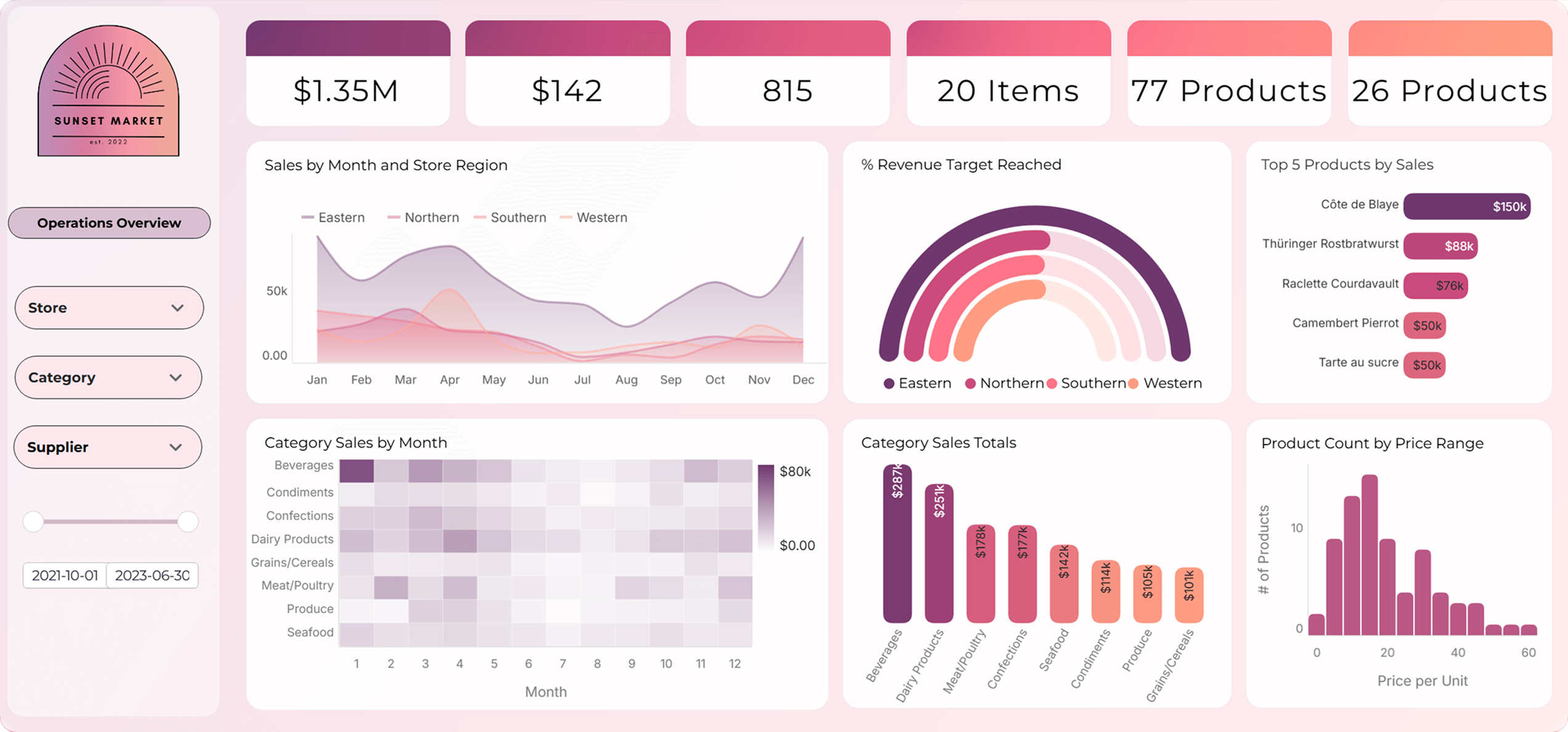
The product serves three core use cases: guided self-service BI for business users who need to explore data without writing SQL, customer-facing embedded analytics for SaaS companies that want to surface analytics inside their own products, and data apps with native writeback that sync changes directly back to the warehouse. The common thread is that Astrato treats the warehouse as the analytics layer — not a source to extract from.
Row-level security, role-based access, and data governance are all inherited from the warehouse itself. Define access controls once; they apply everywhere, automatically.
What is Domo?
Domo is a cloud-based business intelligence and data products platform founded in 2010 by Josh James, previously the founder of Omniture. It's publicly traded on NASDAQ and counts 2,600+ customers across retail, healthcare, financial services, and media. With over 1,000 pre-built data connectors and a mobile-first experience that executives have used since the iPhone era, Domo built genuine momentum solving a real problem: fragmented data across dozens of SaaS tools, with no easy way to surface KPIs to non-technical users.
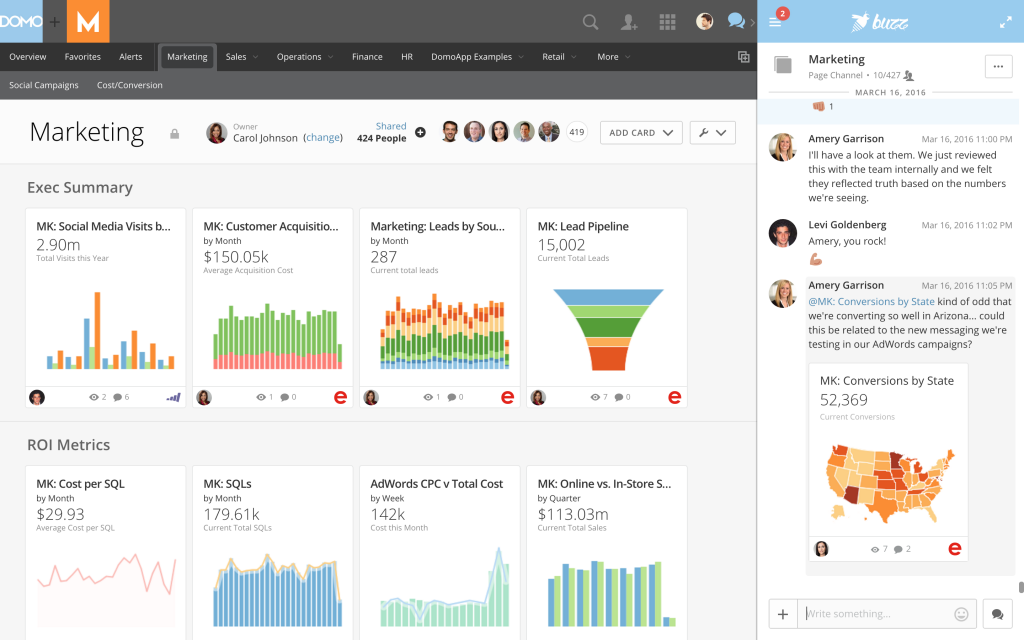
The platform covers the full stack — data ingestion, ETL (via Magic ETL), transformation (via Beast Mode formulas), dashboarding, embedded analytics (via Domo Everywhere), and now an AI platform (Domo.AI) that includes natural language query, an Agent Builder, and an MCP server announced for 2026. For organizations without a central data warehouse and with a heavily field-based or mobile workforce, Domo remains one of the few platforms that delivers all of this from a single vendor.
Where it gets complicated is the underlying architecture — and what happens at renewal.
The architectural difference that actually matters: live query vs extract-first BI
Domo's default mode is extraction. When you connect a data source, Domo pulls that data into its proprietary Data Vault — its own managed storage layer — before any query runs. That was a reasonable design choice in 2010, when cloud data warehouses didn't exist and data lived in Salesforce, Google Sheets, and on-premise SQL servers. If you wanted analytics, you needed somewhere to put the data first.
The problem in 2026 is that most enterprise data teams have already solved this problem. They have Snowflake, BigQuery, or Databricks. Those platforms were built specifically to store and query data at scale, with sophisticated access controls, semantic layer support, and optimized compute. Paying Domo to copy that data into a second proprietary store means paying for duplicate storage, maintaining two separate governance layers, and losing data freshness — all while burning Domo credits every time that copy is refreshed.
Domo does offer federated queries via Cloud Amplifier for Snowflake and Databricks, but this is a secondary mode. The default architecture is still extract-and-store. Astrato has no such extraction step. Every query is live pushdown SQL against your cloud data warehouse — no intermediate storage, no duplication, no credits consumed for refreshes that shouldn't be necessary.
For teams that have invested in Snowflake or Databricks as their analytical foundation, the warehouse-native approach isn't just architecturally cleaner — it means access controls, version control over data models, and security policies all live in one place. Astrato's semantic layer surfaces those definitions directly for business users, without requiring data engineers to maintain a separate system.
Embedded analytics and customer-facing reporting: add-on vs built-in
Domo Everywhere is a capable embedded analytics product. It supports iFrame embeds, a JavaScript SDK, APIs, multi-tenancy, and a Brand Kit for white-labeling. If you're building customer-facing analytics on top of Domo, you can do it. The catch: Domo Everywhere is a separately priced add-on, starting around $3,000 per month according to SelectHub research. It's not included in the base Domo contract. For SaaS companies building embedded analytics into their product, that's a line item they negotiate on top of an already expensive and opaque base license.
Astrato's embedded analytics capability is part of the core product. Pixel-perfect white-labeling, multi-tenancy, and an SDK for embedding interactive dashboards in customer-facing products — no separate add-on negotiation required. For a COO evaluating BI tools to power their product's analytics feature, that distinction changes the math significantly.
There's also a fundamental difference in how the two platforms serve customer-facing analytics. Domo Everywhere routes queries through Domo's Data Vault — so even your customers' embedded dashboards are querying Domo's copy of your data, not the warehouse directly. Astrato's embedded analytics runs live against the warehouse. If your data changes, the customer sees it immediately.
Self-service analytics at scale: drag-and-drop without the proprietary trap
Both platforms target non-technical business users. Domo's Magic ETL provides a drag-and-drop interface for data transformation, and its Analyzer tool lets users build dashboards without SQL. For operations managers, field sales teams, and business users who need to explore data without any technical expertise, Domo has invested heavily in this experience.
Astrato's guided self-service approach takes a different path. Rather than copying raw data into a proprietary system and building transformation tools on top, Astrato surfaces a governed semantic layer that gives business users access to pre-defined metrics, dimensions, and relationships — all grounded in the warehouse. Non-technical users explore data through a visual query builder. They're querying real-time warehouse data, not a cached approximation.

The difference becomes material when Domo's proprietary tooling becomes its own kind of barrier. Magic ETL and Beast Mode formulas require Domo-specific expertise to build and maintain. When business users want to self-serve, someone has to build and govern those transformation pipelines. G2 reviewers consistently flag the implementation complexity — "Learning Curve" appears 60 times as a con in Domo's G2 aggregate, and professional services are almost always required for meaningful deployment.
Domo's data apps and Workflow features are genuine capabilities — App Studio for low-code application development, Bricks for pre-built code templates, and an Appstore with 1,000+ connectors. For organizations that want to build internal data apps on top of BI, this is a real differentiator. Astrato's operational workflows focus more narrowly on the writeback use case — enabling business users to make decisions and push data changes directly back to the warehouse without engineering involvement.
Native writeback: the difference between bi-directional and warehouse-native
Domo supports writeback — it's not missing. Data can flow back through ODBC connections, APIs, and writeback connectors. The architecture, though, is the same as the read path: data routes through Domo's platform and connectors, not directly to the cloud data warehouse. For teams that have Snowflake or Databricks as their operational system of record, that routing creates an indirect path where a direct one should exist.
Astrato's writeback is direct. Business users update values in a dashboard, and those changes write back to the warehouse in real time — no intermediate system, no custom engineering required to wire the path. For operational workflows where analysts update forecasts, sales teams adjust targets, or finance teams reconcile numbers, that directness matters.
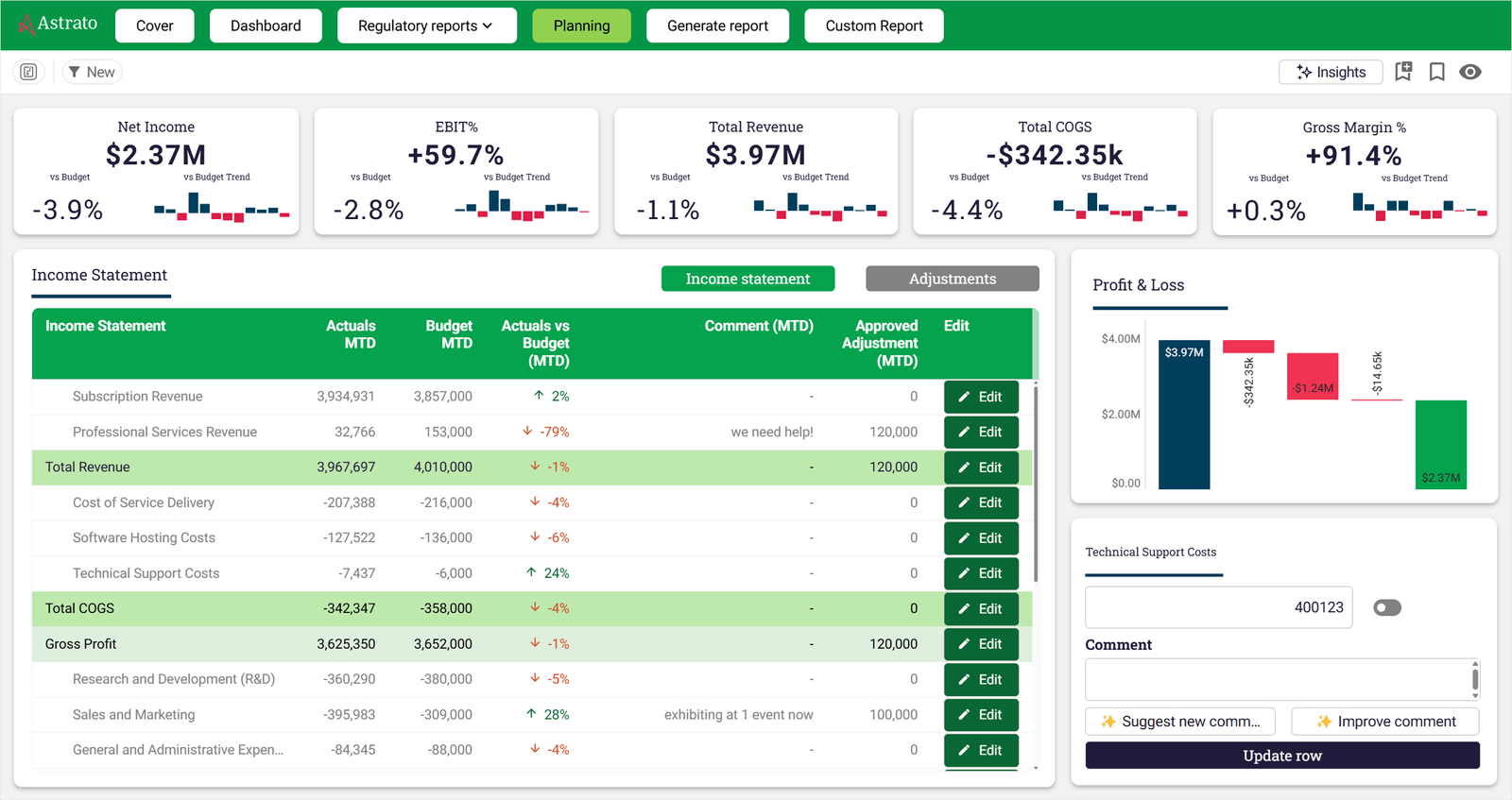
This isn't a marginal difference for data-intensive products. Teams that need to combine data from multiple sources, run analyses, and push decisions back to the operational data layer find that routing writeback through a vendor's proprietary system adds friction that builds up over time.
AI-powered analytics: agent-first vs warehouse-grounded
Domo's AI investment is serious. Domo.AI includes natural language query, an Agent Builder for agentic workflows, an Agent Catalyst framework that lets users select their LLM and connect it to data sources, an AI Library, and an MCP server announced for 2026. Dresner Advisory ranked Domo as the #1 vendor in its 2025 Agentic AI Report. The platform is shipping fast and the ambition is real.
One structural note: Domo's AI queries run against data in the Data Vault. If your warehouse is Snowflake or BigQuery and you want AI-powered insights grounded in your most current data, the answer depends on how fresh that copy in Domo's vault is — which, in turn, depends on your refresh schedule and how many credits you're willing to spend.
Astrato's GenAI features are grounded in the semantic layer and integrated with Snowflake Cortex, Gemini, and OpenAI. Natural language queries run against live warehouse data. AI-powered insights reflect what's actually in Snowflake or BigQuery at that moment — not what was copied there at the last scheduled refresh. For data teams and analytics engineers who want AI that works with their existing stack rather than around it, that distinction is meaningful.
Pricing: what "pay for what you use" actually costs
Domo doesn't publish pricing. Its pricing page shows a 30-day free trial and a "Contact Sales" button. Based on verified third-party data from Vendr's 84-deal dataset, G2, and TrustRadius, Domo contracts typically range from $30,000/year for small deployments to $500,000+ for enterprise. The average across Vendr's dataset: $134,000/year.
The consumption credit model replaced per-seat pricing in mid-2023. Customers buy a pool of credits. Every data action consumes from that pool: ingestion, ETL transformations (double-billed — credits charged on both input and output), dashboard refreshes, and Domo AI Pro queries. There are no hard caps. Overages accumulate until end of quarter. Storage beyond the included allocation adds $10,000–$20,000+/year. Additional connectors beyond the base package can cost $5,000–$15,000 per connector per year. Domo Everywhere, the embedded analytics product, is a separate line item starting around $3,000/month.
The renewal escalation issue is documented, not anecdotal:
The credit model's logic makes sense on paper: pay for what you consume. In practice, it creates predictability problems. Every action you take costs something. Democratizing data access — giving more business users dashboards and data exploration — becomes a cost center that scales with usage, not with value delivered.
Astrato's pricing is published and transparent — per-user, usage-based, or hybrid depending on the deployment. No hidden credit consumption. No separate embedded analytics add-on negotiation. If you're a data team trying to build a predictable analytics budget, that transparency matters more than it sounds.
Governance, data security, and row-level security
Both platforms take governance seriously. Domo's Personalized Data Permissions (PDP) system allows row-level security with attribute-based access controls. It's SOC 2, GDPR, and HIPAA compliant. Domo also introduced Data Models at Domopalooza 2025, providing a semantic layer for metric governance that was a notable gap in prior versions.
Astrato's approach starts from a different premise: governance is already defined in the warehouse. Role-based access, row-level security, and data security policies set in Snowflake or BigQuery apply automatically in Astrato — no separate configuration, no risk of the BI layer granting access that the warehouse would deny. For enterprise data teams running access controls and compliance programs at the warehouse level, maintaining a parallel governance layer in a BI tool adds overhead with real risk.
For teams that need to combine data from multiple sources with consistent security policies, the warehouse-inherited approach means those policies travel with the data — not with the BI platform.
Scheduled reporting and executive delivery
Domo's scheduled reporting is mature. The PDF Report Builder, introduced at Domopalooza 2025, supports scheduled email delivery, mobile push notifications, and in-app alerts. For executives who want formatted reports delivered to their inbox on a schedule, this is a solid, well-developed feature.
Astrato's reporting and distribution covers the same ground — automated branded reports in Excel, PDF, and PPT formats, delivered to email or Slack on a defined schedule. For business intelligence teams that need to generate reports for stakeholders who don't log into dashboards, both platforms handle this well. The distinction in this area is less architectural and more about fit with an organization's delivery preferences.
Vendor lock-in: Magic ETL, Beast Mode, and the cost of leaving
This deserves its own section because it's often the last thing people think about and the first thing they wish they had.
Every Domo deployment involves three proprietary layers: Magic ETL for no-code data transformation, Beast Mode formulas for calculated fields and metrics, and the Data Vault for storage. None of these translate to anything outside of Domo. If you decide to move to a different BI tool — whether because of a renewal price increase, a product gap, or a change in strategy — you're rebuilding your ETL pipelines, your metric definitions, and your dashboard logic from scratch.
That's not a theoretical risk. It's the migration cost that lands in every Domo exit conversation. Data teams that have spent years building Beast Mode formulas and Magic ETL dataflows have accumulated technical debt that's invisible until migration day.
Astrato uses standard SQL throughout. The semantic layer is built on open definitions that live in or alongside the warehouse. Analytics engineers who know SQL can work with Astrato's data modeling without learning a proprietary language. If your requirements change, the path forward doesn't require burning down what you've built.
When to switch from Domo to Astrato
- You're approaching a Domo renewal and the price has increased — or you're worried it will. The consumption credit model compounds, and Domo's track record on renewals is documented.
- Your team has invested in Snowflake, BigQuery, or Databricks as the data foundation, and you're questioning why you're also paying Domo to copy that data and store it separately.
- You're building or expanding embedded analytics for your SaaS product and have been quoted a Domo Everywhere add-on fee on top of the base contract.
- Your data engineers are spending time maintaining Magic ETL pipelines and Beast Mode formulas instead of working in standard SQL against the warehouse.
- Business users want to explore data in real time, but Domo's dashboard freshness depends on how often refreshes run — and running them more often costs more credits.
- You need writeback to the warehouse, not writeback through Domo's proprietary system.
FAQ
What is the best alternative to Domo?
The right alternative depends on your architecture. If your data lives in a cloud warehouse like Snowflake, BigQuery, or Databricks, a warehouse-native BI tool like Astrato eliminates the data duplication and vendor lock-in that are Domo's primary weaknesses. If you don't have a central warehouse and need to connect dozens of SaaS tools without data engineering, Domo's connector library is harder to replace.
How does Astrato compare to Domo?
Astrato is warehouse-native — it queries Snowflake, BigQuery, Databricks, and others live, with no data extraction or copies. Domo's default architecture extracts data into its proprietary Data Vault before querying. Astrato includes embedded analytics in the core product; Domo charges for Domo Everywhere separately. Astrato's pricing is published; Domo's is not.
Why is Domo so expensive?
Domo's consumption credit model means every data action — ingestion, ETL processing (billed on both input and output), dashboard refreshes, and AI queries — draws from a pre-purchased credit pool with no hard caps. Renewal price escalations are documented in G2 reviews. The average Domo contract runs around $134,000/year per Vendr's dataset, with enterprise deployments reaching $500,000+.
How does Domo's credit pricing model work?
Customers purchase a pool of credits. Credits are consumed by data ingestion, Magic ETL transformations (double-billed — credits for input rows and output rows), scheduled dashboard refreshes, and Domo AI Pro queries. Overages accumulate without hard caps and are billed at end of quarter. There is no published pricing on Domo's website.
Does Domo support live query from Snowflake?
Yes, via Cloud Amplifier — Domo's federated query layer for Snowflake, BigQuery, and Databricks. However, this is a secondary mode. Domo's default architecture still extracts data into the Data Vault. Cloud Amplifier provides federated access with approximately 15-minute intervals for most cloud warehouse connections.
What is Domo Everywhere and how is it priced?
Domo Everywhere is Domo's embedded analytics product, supporting iFrame embeds, a JavaScript SDK, APIs, white-labeling via Brand Kit, and multi-tenancy. It's a separately priced add-on not included in the base Domo contract. Starting price is approximately $3,000/month based on SelectHub research, with OEM deployments often reaching six figures.
Can Astrato replace Domo for embedded analytics?
Yes. Astrato's embedded analytics includes white-labeling, multi-tenancy, SDK embedding, and interactive dashboards — as part of the core product, not a separate add-on. For SaaS companies building customer-facing analytics into their product, Astrato removes the separate Domo Everywhere negotiation and routes queries live against the warehouse rather than through Domo's Data Vault.
What is the difference between Domo and warehouse-native BI?
Domo extracts data from source systems into its own proprietary Data Vault before any analysis can run. Warehouse-native BI tools like Astrato connect directly to the warehouse and run queries live — no extraction step, no data copy, no duplicate storage. The practical difference: warehouse-native BI keeps data governance in one place, eliminates refresh schedules, and doesn't charge for storage of a second copy of your data.
Why are companies switching away from Domo?
The most common reasons cited on G2 and TrustRadius: pricing unpredictability and renewal escalations from the credit model, implementation complexity (Magic ETL and Beast Mode have steep learning curves), performance issues at scale, and vendor lock-in from proprietary tooling that makes migration costly.
Does Domo have vendor lock-in?
Yes. Magic ETL, Beast Mode calculated fields, Domo Apps, and the Data Vault are all proprietary to Domo. Migrating to another BI tool requires rebuilding ETL pipelines, metric definitions, and dashboard logic in a new system. This lock-in is cited by migration consultants and G2 reviewers as a significant barrier to switching.
How does Astrato's pricing compare to Domo?
Astrato publishes its pricing. Domo does not. Astrato uses per-user, usage-based, or hybrid pricing with no hidden credit consumption. Domo's credit model produces variable bills based on data volume, refresh frequency, and ETL complexity — with documented renewal escalations of 1,000%+ in verified G2 reviews.
What is Magic ETL and what replaces it?
Magic ETL is Domo's no-code, drag-and-drop data transformation tool. It processes data before loading it into the Domo Data Vault. Because Magic ETL is proprietary to Domo, transformations built in it don't migrate to other platforms. Astrato handles data preparation at the semantic layer level, using standard SQL definitions that analytics engineers and data scientists can version-control and maintain in their existing toolchain.
Is Domo good for SaaS companies that want embedded analytics?
Domo Everywhere is a capable product, but it's a separately priced add-on that requires its own negotiation on top of an already expensive base contract. For SaaS companies where embedded analytics is a core product feature — not a side requirement — Astrato's approach of including it in the core platform tends to be a better fit architecturally and commercially.
Final verdict
Domo built something real. For organizations with highly fragmented data across dozens of SaaS tools — no central warehouse, a field-based workforce, and executives who want KPIs on their phones — the 1,000+ connector library, Magic ETL, and mobile-first experience solve genuine problems that other BI tools haven't matched. If that describes your organization, Domo is still a legitimate choice.
The structural issue is what happens when your data situation has matured. If you've invested in Snowflake, BigQuery, or Databricks as your analytical foundation, Domo's default architecture works against that investment. You're paying to copy data into a second storage system, maintaining governance policies in two places, and consuming credits every time that copy refreshes. The value Domo was built to deliver — consolidating fragmented data for business users — is a problem you've already solved at the warehouse level.
Astrato's clearest wins in this comparison: transparent and predictable pricing with no credit consumption model, a warehouse-native architecture that eliminates data duplication and keeps governance in one place, native writeback directly to the warehouse, and embedded analytics included in the core product rather than sold as a separate add-on. For data teams, the absence of proprietary lock-in — no Magic ETL to maintain, no Beast Mode formulas to rebuild — is a meaningful operational difference.
The question isn't whether Domo works. It's whether the architecture, pricing model, and vendor relationship that come with Domo are the right foundation for where your analytics is going.
Book a demo and see how Astrato runs analytics directly on your warehouse.




.avif)


